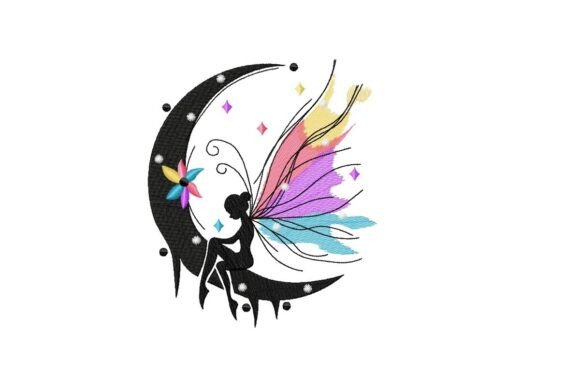
Magic Butterfly Fairy Embroidery Design
A Whimsical Yet Refined Statement for Boutique Apparel
As an embroidery designer who’s developed over 200+ collections for small clothing brands and Etsy sellers, my first glance at the Magic Butterfly Fairy Embroidery Design stopped me mid-scroll. It’s not just another “cute bug” motif — it’s a balanced fusion of delicate storytelling and technical intention. The fairy perches gracefully on a crescent moon, wings unfolding in layered, colorful gradients that suggest movement without visual clutter. This isn’t cartoonish or overly sweet; it leans into elegance with a touch of quiet magic — perfect for brands building identity around wonder, soft femininity, or mindful creativity.
How It Performs Across Real Apparel Surfaces
I tested the Magic Butterfly Fairy Embroidery Design across several garment types common in boutique sweatshirt and hoodie collections — neutral heather grey sweatshirts, blush pink hoodies, charcoal denim jackets, oatmeal t-shirts, and natural canvas totes. On medium-weight fleece and cotton-blend hoodies, the design held crisp definition without puckering — especially when paired with a medium-weight cutaway stabilizer. The crescent moon base anchors the composition beautifully on curved chest placements, and the wings’ gentle arc follows the natural drape of relaxed-fit garments.
For sweatshirt embroidery, I placed it centered on the left chest (2.5" width) — it read clearly without overwhelming the garment’s casual luxury. On oversized hoodies, scaling up to 3.75" worked elegantly on the back yoke, where the moon’s curve echoed the shoulder line. As a hoodie design, it also shines subtly on sleeve cuffs — rotated 90° and reduced to 1.8", it becomes a whisper of detail rather than a statement.
The Magic Butterfly Fairy Embroidery Design translates exceptionally well to tote bag design and denim jacket accents. Its moderate stitch density avoids stiffness on woven fabrics, and the wing details retain dimensionality even on heavier canvas. For custom apparel targeting teens and young adults, it adds narrative depth without aging poorly — unlike trend-heavy motifs, this feels timeless enough for seasonal rotations.
Strategic Placement & Fabric Considerations
This is not a one-size-fits-all machine embroidery design. Its strength lies in thoughtful placement. Avoid high-stretch zones like side seams or ribbed waistbands unless you reinforce with tear-away + cutaway combo stabilizer. On curved surfaces — think hooded neckline edges or tapered sleeves — test hoop alignment carefully: the crescent moon’s curvature can distort if hooped too tightly or misaligned.
On dark garments, contrast matters. The original thread colors appear designed for light-to-mid fabrics, so for black or navy apparel, consider substituting metallic silver or iridescent thread in the wing highlights to maintain luminosity. Also, inspect the inner wing fill: some versions include dense satin stitches — if your fabric is lightweight jersey or slub cotton, reduce density slightly or add floating stabilizer beneath.
While categorized under Bugs, this Embroidery design transcends literal taxonomy. It’s less about entomology and more about symbolic charm — making it versatile for lifestyle branding beyond children’s wear. Think cozy seasonal outfits: layered under cardigans, embroidered on knit beanie bands, or scaled down for pocket flaps on corduroy jackets.
Impact on Brand Identity & Customer Perception
In my experience, a single well-chosen digital embroidery file can elevate an entire small shop product line. The Magic Butterfly Fairy Embroidery Design adds perceived value instantly — it signals craftsmanship, attention to detail, and emotional resonance. Customers browsing Etsy or Instagram often pause longer on pieces that tell a micro-story. A fairy on a moon isn’t just decoration; it invites interpretation, memory, and connection.
For a boutique brand building cohesive visual consistency, this design works as both hero motif and supporting element. Use it full-size on hoodies, simplified line-art version (if included in Creative Fabrica files) for tags or packaging, and cropped wing fragments for social media graphics. That flexibility strengthens product recognition across touchpoints — from printable mockups to lifestyle product photos.
Practical Designer Notes Before You Stitch
Before committing to production, always:
- Test on scrap fabric matching your final garment’s weight and stretch — especially critical for fleece or brushed cotton;
- Confirm hoop size compatibility; the crescent moon’s span may require a 5x7" hoop minimum for full fidelity;
- Review stitch density in your embroidery software — look for smooth transitions between wing layers and avoid overlapping satin columns that could cause thread breaks;
- Check stabilizer choice: medium cutaway for knits, tear-away for stable wovens, and fusible + cutaway for ribbed cuffs;
- Compare placement options using printable mockups — the fairy’s orientation changes dramatically when flipped or rotated;
- Verify Creative Fabrica product details: confirm included embroidery file formats (PES, DST, EXP, JEF, etc.) and licensing terms for commercial embroidery use;
- Inspect thread color contrast on your actual fabric swatches — monitor calibration varies widely.
Final Thought: More Than Just a Design File
The Magic Butterfly Fairy Embroidery Design stands out because it bridges aesthetic appeal and functional intelligence. It’s feminine without being fragile, magical without being childish, detailed without being fussy. For Etsy sellers, handmade product creators, and creative entrepreneurs building a differentiated custom apparel line, it offers instant narrative texture — something customers photograph, tag, and remember. In a market saturated with generic florals and typography, this Creative Fabrica embroidery piece delivers quiet distinction. Not every butterfly needs to shout — sometimes, the most memorable ones simply glow softly on the edge of the moon.