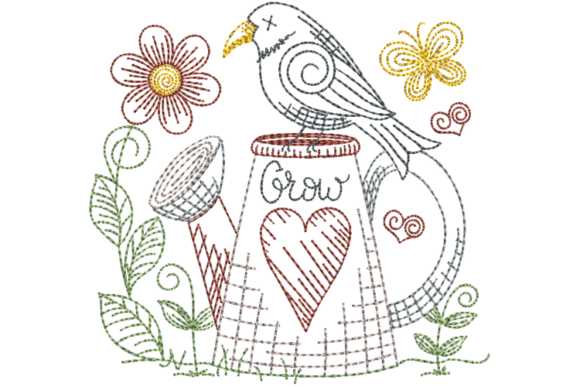
Primitive Grow Crow Embroidery Design
First Impression: Rustic Charm with Quiet Confidence
The Primitive Grow Crow Embroidery Design lands exactly where it should—firmly in the sweet spot between whimsy and grounded authenticity. It’s not loud, but it’s magnetic: a primitive-style crow perched on a watering can, crowned with a patchwork heart and the word “Grow.” That single verb does heavy lifting—it whispers encouragement, nods to gardening, growth, and gentle resilience. Customers at craft fairs don’t just see a bird; they feel a story. This isn’t cartoonish or overly cutesy. It’s farmhouse-adjacent but with soul—rustic without being dusty, decorative without feeling fussy. For handmade product creators, that balance is gold.
Where It Shines: Craft Fair-Ready Product Pairings
This design thrives where handmade warmth meets everyday utility. On a natural linen tote bag? Instant booth standout—subtle enough for minimalist shoppers, rich enough for texture lovers. As apron embroidery, it anchors the chest pocket beautifully: the crow’s posture reads clearly from three feet away, and “Grow” becomes a quiet mantra for bakers, gardeners, and makers alike. For tea towel embroidery, the watering can motif feels intentional and functional—not forced. It also scales well as an embroidered patch: iron-on or sew-on, it adds instant character to denim jackets or market bags without overwhelming.
On small-format items like fabric pouches or pillow covers, the Primitive Grow Crow Embroidery Design holds its own—but only if stitched at 3.5"–4.5" wide. Below 3", the patchwork heart and lettering risk blurring. As a tote bag design, it shines best centered or slightly off-center on the front panel—not tucked into a corner. And yes, it works on caps—but only on structured, medium-crown fronts with smooth twill or cotton canvas. Avoid curved visors or heavily textured fabrics unless you’ve tested stabilizer layers first.
What Makes It Sell: Attention, Value, and Repeat Appeal
At a crowded craft fair, this design stops scrollers. Why? It’s legible at a glance (“Grow” reads instantly), emotionally resonant (hope + nature + handmade), and stylistically cohesive across product types. Buyers don’t need to “get it”—they *feel* it. That emotional hook lifts perceived value: a $28 tea towel feels like a curated keepsake, not just kitchen linen. For Etsy sellers, it supports strong printable mockup visuals—especially against oat, sage, or charcoal backgrounds—and pairs effortlessly with botanical or neutral-themed shop banners.
It also reinforces brand consistency. If your small shop leans into slow living, cottagecore, or garden-inspired goods, this design becomes a visual anchor—reusable across seasons without feeling dated. It doesn’t scream “holiday,” so it’s evergreen. And because it’s rooted in the Birds category yet avoids cliché (no robins, no flamingos), it stands out in search results and physical displays alike.
Production Reality Check: Know Before You Hoop
This is where experience matters. The Primitive Grow Crow Embroidery Design includes delicate elements—a patchwork heart, fine line work on the crow’s feathers, and tight lettering in “Grow.” That means stitch density will impact clarity, especially on textured towels or thick canvas. Always test on scrap fabric *first*, using your intended thread colors and stabilizer combo. A tear-away alone won’t cut it for dense areas; pair it with light cutaway for stability without stiffness.
Check spacing: Does the crow’s wing clear the watering can’s handle? Does the heart sit cleanly within the can’s spout curve? Confirm hoop size—this design likely fits comfortably in a 4x4 or 5x7, but don’t assume. If your machine struggles with jump stitches near the heart’s edges, adjust trim settings. And never skip the real mockup: stitch one full sample on your target fabric *before* batching. A $12 tea towel looks lovely online—but under fair lighting, low-contrast thread on oat linen can vanish. Test contrast. Then test again.
Careful-Use Notes for Handmade Sellers
- Tiny details matter: The patchwork heart and “Grow” lettering lose definition below 3". Avoid scaling down for patches smaller than 2.75".
- Fabric texture is a factor: Highly napped terry cloth or thick duck canvas may obscure fine lines. Opt for medium-weight linen, quilting cotton, or brushed twill instead.
- Dark fabric demands attention: Use high-contrast thread (cream on navy, mustard on charcoal) and consider satin-stitch fill over fill-stitch for better definition.
- Curved surfaces require planning: Caps and pouches need re-hooping or specialty hoops. Don’t force this design onto a baseball cap back panel—it belongs on the front.
- Thread colors shape mood: Stick to earthy palettes—olive, rust, slate, oat—to honor the primitive aesthetic. Bright neon threads break cohesion.
Final Designer Verdict: A Thoughtful, Booth-Strong Asset
The Primitive Grow Crow Embroidery Design isn’t flashy—but it’s deeply effective. It’s the kind of machine embroidery design that earns second glances, sparks conversations (“Is that a crow? What does ‘Grow’ mean?”), and converts browsers into buyers who return for matching aprons next season. It performs across commercial embroidery applications, supports strong Etsy seller listings, and elevates any small shop product with quiet craftsmanship.
Before adding it to your lineup: confirm your digital embroidery file includes clean jump stitches and optimized underlay; verify commercial licensing if selling finished goods; and most importantly—stitch it, hold it, photograph it, and ask yourself: *Does this feel like something my customer would choose to keep, use, and love?* If yes, it’s ready. Your booth—and your buyers—will thank you.